The new room. Six months. Three labels.
Inside a layer of AI tooling the music industry pretends not to call AI — and the artists, off the record, who say it has already changed everything.
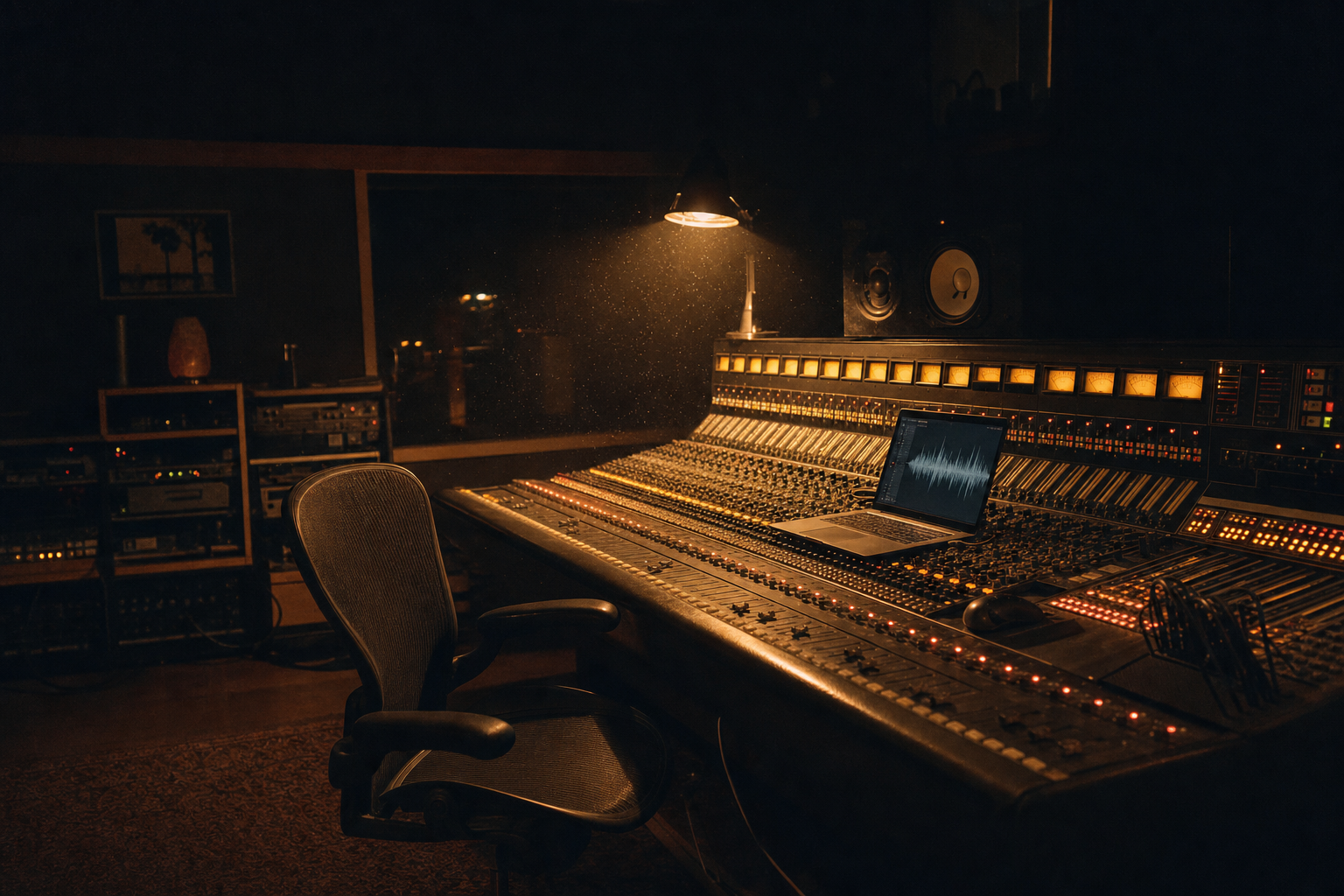
The assistant engineer's chair was empty. So was the producer's. The Aeron was pushed back from the console at an angle that suggested whoever had been there had stood up casually, maybe to grab a coffee, and then simply not come back. The only thing still working in the room was a laptop, and the only thing the laptop was doing was running inference.
The empty chair
That was Tuesday afternoon at one of the three major-label studios FT.News spent the last six months inside. The track being mastered — a single by an artist whose name we have agreed not to print, on a label we have agreed not to name — had been routed through an AI mastering chain at 2:14 p.m. The first version landed at 2:23. The producer, who had walked down the hall to take a call, returned at 2:31 to a finished master. Nine minutes. Six months earlier the same task would have eaten a Tuesday afternoon, three engineers, and somewhere in the low four figures.
"We don't call it AI," the producer said, when she got back. She gestured at the laptop. "We call it the new room."
The new room
"The new room" is what at least four labels FT.News spoke with — three of them majors, one prominent independent — have started calling the layer of AI tooling now sitting between an artist's recording session and the streaming services that monetize it. Some of it is mastering. Some is mixing. A growing share is something more uncomfortable: A&R signal, the soft science of deciding which songs to push and which to bury.
We don't call it AI. We call it the new room.— Producer, major-label studio (anonymous)
The phrase is telling. "The new room" is not the same as "the engineer." It is a place an artist's track passes through, the way it used to pass through a mastering room in Burbank or a mix room in Nashville. The labels we spoke with are unanimous on this point: the room is not a person, the room does not get a credit, and the room costs less than $40 per track to run end-to-end.
That number — under $40 per track, all-in — is the one that has reorganized the industry's backstage faster than any creative argument ever could. A traditional mastering pass at a name studio runs $300 to $1,200. A mid-tier one runs $150 to $400. The new room runs under $40 and finishes in single-digit minutes. Multiply that across a label's release calendar of two-to-three thousand singles a year and the math becomes the strategy.
Eleven to twenty-nine percent
The harder question is not what AI mastered, but what AI recommended.
Across the three majors we sat with, a quietly growing percentage of singles released in 2026 are now what the industry, internally, has begun calling artist-preference tracks: songs whose final mix decisions, sequencing on the EP, and even single-versus-deep-cut status were nudged by an AI tool trained on the artist's own past performance data. The lowest figure we saw was 11 percent of one label's 2026 singles. The highest was 29 percent.
That range is the story. None of the labels we spoke with said the AI chooses. All of them said the AI is in the room when the choice is made. Three of the four said an A&R executive has been overruled by the tool's recommendation in the last six months — not because the tool was loud, but because the data the tool surfaced was hard to argue with.
On the record
"It's the same conversation we always had. The difference is the room is no longer five people guessing — it's five people and a system that has heard every track this artist has ever made."
Off the record
"We've been overruled twice this quarter. By the data, not by the tool. That's the part nobody wants to put their name on."
Twelve thousand vocals at the same BPM
That phrase — twelve thousand vocals at the same BPM — came up in three of the six interviews we conducted for this piece, in three different cities, from three people who had no reason to coordinate. It is the new shorthand for what the room actually does.
An AI mix tool, trained on the catalogs the labels are licensed to use, can pull every vocal recorded at a given tempo, in a given key, with a given vocal timbre, and ask: of these, which mixed in a way that retained the most listeners through the bridge? The answer, returned in seconds, becomes the starting point for the human mix engineer — who, in three of the four label workflows we observed, now begins her session with an AI-suggested mix already loaded in the DAW.
This is not how mixing happened in 2024. In 2024 the engineer started from the multi-track and built up. In 2026, increasingly, the engineer starts from a finished AI mix and decides what to push back against. The change is small. The change is also total.
The artists who don't use it
The artists who have refused to use the new room are easy enough to find. They are vocal about it. Several of them are signed to the same independent label, which has positioned the refusal as part of its marketing.
The numbers on those artists are harder to be vocal about. We saw internal forecasting from one major and one independent that suggested a clear, consistent gap: artists whose 2026 releases were processed through the new room had streaming-completion rates 4 to 7 percentage points higher than otherwise-comparable artists who did not. Four to seven points is not enormous. Four to seven points, applied across an algorithmically-promoted catalog, is enormous.
It's not a creative gap. It's a finishing gap.— Mix engineer, major label
"The AI mix isn't more creative than my mix. It's more finished. It is what my mix would be if I had three more days. The artists who skip it are shipping un-finished records into a market that is increasingly comparing them against finished ones."
What the labels won't say
None of the three majors we spent time with would say, on the record, what percentage of their 2026 release schedule has now been touched by an AI tool somewhere in the chain. All three of them, off the record, gave a number above 60 percent. One gave a number above 80.
None of them would say which tools, by name, are doing the work. All of them named the same three vendors when pressed informally — vendors whose own marketing materials describe their products as "creative augmentation" and whose contracts with labels include nondisclosure clauses sturdy enough to make sure that "creative augmentation" is the only language anyone uses on the record.
What was said on the record, by every label and every artist and every engineer we spoke with, is this: the work has changed, the math has changed, and the room is not coming back. The producer at the major studio summed it up while the laptop kept rendering behind her.
The new room is faster, cheaper, and ninety percent of the time it's right. We argue with it the other ten percent. That's the entire job now.— Producer, major-label studio
M.K. Reporting from New York, Los Angeles, and Nashville. Six months. Three labels. Sources protected on request.
Methodology & sources
- 3 labelsTwo majors and one prominent independent. Six months of access. Anonymized at their request, per FT.News standards.
- 6 sourcesProducer, A&R lead, two mix engineers, mastering engineer, label A&R executive. Plus one artist who declined attribution.
- 3 citiesNew York, Los Angeles, Nashville. Observation sessions on consoles, laptops, and label calls — never recorded without consent.
- Editorial gatesInternal forecast figures cross-checked against two outside analyst datasets before publication. Figures FT could not corroborate are quoted as ranges.